On this page
The short answer by type of trip
China spans deserts, mountains and subtropical coast, so "best" depends on where you go. For the routes most first-timers take:
| Trip | Best months | Watch out for |
|---|---|---|
| Classic first trip: Beijing, Xi'an, Shanghai | April-May, September-October | May 1-5, October 1-7, Chinese New Year |
| Guilin and Yangshuo | September-November | April-June, the rainiest months |
| Yunnan: Kunming, Dali, Lijiang | October-May (driest November-April) | Rain from June to August |
| Chengdu and the pandas | March-May, September-November | Hot, wet July and August |
| Zhangjiajie | September-October, April-May | Rain peaks May-July |
| Harbin | December-February for ice; June-August for mild weather | January lows near -23°C (-9°F) |
| Tibet | May-June, late September-October | July-August rain; permits required |
If we had to pick one window for a first trip, it would be the second half of October: after the Golden Week crowds, dry and cool in Beijing, mild in Shanghai and Guilin.
Month by month
Temperatures are average daily highs from the China Meteorological Administration's 1981-2010 averages. Any given week can be warmer or colder, so check a forecast before you pack.
| Month | North (Beijing) | East (Shanghai) | South-west (Guilin, Kunming, Chengdu) | Crowds | Good for |
|---|---|---|---|---|---|
| January | Freezing and dry, 2°C (35°F) | Damp and chilly, 8°C (47°F) | Kunming dry and mild, 16°C (61°F); Guilin 12°C (53°F) | Quiet until the New Year rush (from about Jan 22, 2027) | Harbin ice festival, Yunnan |
| February | Cold and dry, 6°C (43°F) | Chilly, 10°C (50°F) | Kunming dry, 18°C (64°F) | Chinese New Year on Feb 6: trains and flights full | Harbin, Yunnan, New Year lanterns |
| March | Cool and dry, 13°C (55°F) | Cool and wetter, 14°C (57°F) | Kunming 21°C (70°F); Chengdu 16°C (61°F) | Quiet once the rush ends in early March | Yunnan, Chengdu |
| April | Pleasant, 21°C (69°F) | Mild, 20°C (68°F) | Guilin's rain picks up (218 mm); Kunming 24°C (75°F) | Busy over Qingming (expected Apr 3-5) | Beijing, Xi'an, Shanghai, Zhangjiajie |
| May | Warm, 27°C (81°F) | Warm, 25°C (77°F) | Guilin very wet (324 mm); Yunnan's rains begin | Packed May 1-5, calm after | The classic route after May 5 |
| June | Hot, 31°C (87°F) | Plum rain season, humid, 28°C (83°F) | Guilin's wettest month (395 mm) | Moderate; Dragon Boat Festival Jun 9 | Beijing early in the month, Harbin |
| July | Hot and wet, 32°C (90°F) | Hot and humid, 33°C (91°F) | Kunming 24°C (76°F) but rainy | School holidays | Harbin, Yunnan's high country |
| August | Hot and wet, 31°C (87°F) | Hot, typhoons possible | Chengdu hot and wet (208 mm) | School holidays | Harbin, Yunnan's high country |
| September | Warm and drier, 27°C (80°F) | Warm, 28°C (83°F), typhoons possible | Guilin drier, 31°C (87°F) | Calm; Mid-Autumn Festival Sep 15 | The classic route, Guilin, Tibet |
| October | Crisp, 19°C (67°F) | Comfortable, 23°C (74°F) | Guilin 26°C (79°F) and dry | Golden Week Oct 1-7 is packed | Almost everywhere after Oct 7 |
| November | Cold, 10°C (50°F) | Cool, 18°C (64°F) | Kunming 18°C (64°F), dry season | Quiet | Shanghai, Guilin, Yunnan |
| December | Freezing and dry, 4°C (38°F) | Chilly, 11°C (52°F) | Kunming 16°C (60°F) | Quiet; Christmas is a normal workday | Harbin, Yunnan, quieter sights |
Weather by region
Beijing and the north
Beijing has short, pleasant springs and autumns between cold, dry winters and hot summers. Average highs are 21°C (69°F) in April, 27°C (80-81°F) in May and September, and 19°C (67°F) in October. More than half the year's rain falls in July and August. January averages a high of 2°C (35°F) and a low of -7°C (19°F), with almost no rain or snow. Xi'an is a little milder in winter (5°C/40°F in January) and just as hot in July, at about 32°C (90°F).
Winter is workable for the Forbidden City and the Great Wall if you dress for it; wear shoes with good grip, since steps can be icy after snow. Our guide to Great Wall tours from Beijing compares the sections.
Shanghai and the east
Shanghai, Hangzhou and Suzhou have mild springs and autumns: Shanghai averages 20°C (68°F) in April, 25°C (77°F) in May and 23°C (74°F) in October. In June the plum rain (meiyu) season brings long spells of drizzle and humidity; June averages 188 mm of rain in Shanghai and 212 mm in Hangzhou. July and August highs run 32-34°C (90-92°F).
The UK government notes that typhoon season runs from May to November on China's southern and eastern coasts and can disrupt flights and trains, and August is Shanghai's wettest month (198 mm). Winters are damp and chilly, around 8°C (47°F) in January.
Guilin, Yunnan, Chengdu and the south-west
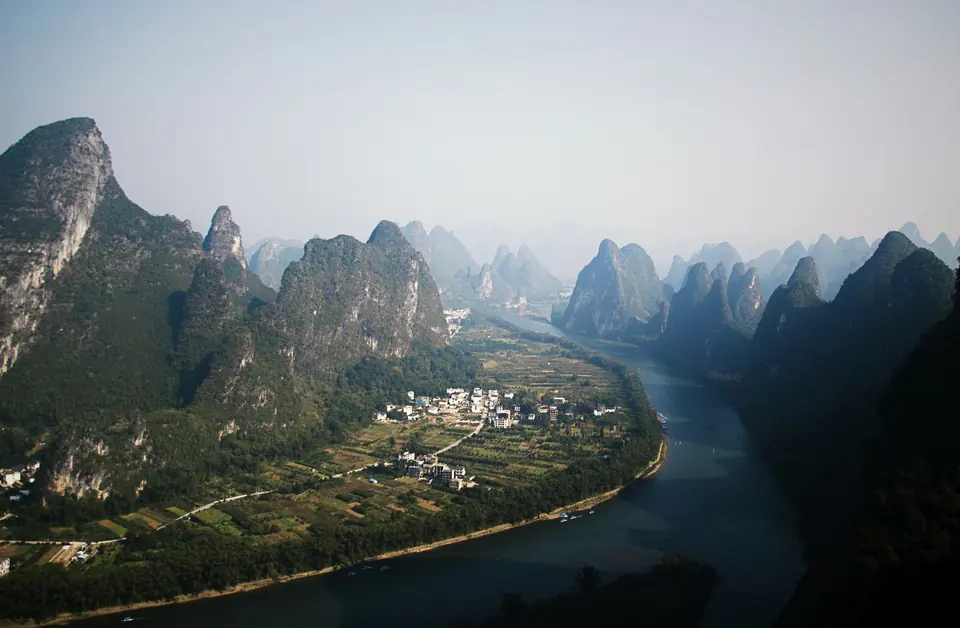
Guilin and Yangshuo: rain peaks from April to June (218 mm, 324 mm and 395 mm a month). September to November is much drier, at 67-82 mm, with highs falling from 31°C (87°F) to 21°C (69°F). January is cool at 12°C (53°F).
Yunnan: Kunming averages highs of 16-25°C (60-76°F) all year. November to April is the dry season, with 14-37 mm of rain a month; June to August brings 170-204 mm. Lijiang is similar but colder at night, with lows near freezing in December and January, and July is its wettest month (242 mm).
Chengdu and Chongqing: Chengdu's July and August average 29°C (84-85°F) with about 200 mm of rain a month; winter highs are 9-10°C (48-51°F). Chongqing is hotter, at 33°C (91-92°F) in July and August.
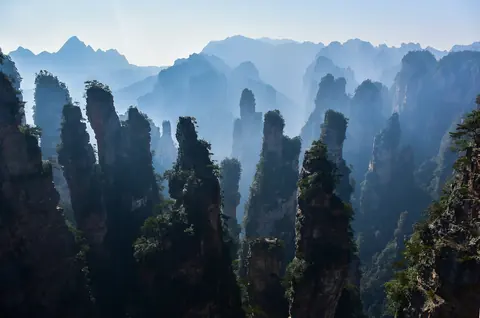
Zhangjiajie: rain peaks from May to July (178-233 mm) and highs reach 33°C (92°F) in July and August, so September and October are the easier months. See our Zhangjiajie guide.
Harbin and the north-east in winter
Harbin's January averages a high of -12°C (10°F) and a low of -23°C (-9°F), and December and February are only slightly milder. That cold is what makes the ice and snow festival possible; our Harbin Ice Festival guide has the 2026-27 season details. Summer is the opposite: highs of 26-28°C (80-82°F) from June to August, with July the wettest month (148 mm).
Tibet and other high-altitude areas
Foreign visitors need a Tibet travel permit arranged through a travel agency in China and must travel on an organized tour. The UK government says the authorities sometimes stop issuing permits without notice, so keep bookings flexible. The 240-hour visa-free transit doesn't cover Tibet.
Lhasa is dry for most of the year, with 7 mm of rain or less a month from October to April, and rainy in July and August (123-125 mm). Highs average 20°C (68°F) in May, 24°C (75°F) in June and 18°C (64°F) in October, while winter nights fall to about -8°C (18°F). Tibet, Qinghai and western Sichuan sit above 3,000 meters, and altitude sickness can be serious, so build in rest days.
Holidays to avoid in 2027
As of October 28, 2026, the State Council had not published the official 2027 holiday schedule. The 2026 schedule came out on November 4, 2025, so expect 2027's around November.
The festival dates below are set by the calendar and match Hong Kong's published 2027 holidays. The days off are our estimate, based on the standard set by the State Council for 2025 onward: eight days from New Year's Eve for the Spring Festival, five days for May Day, seven days from October 1 for National Day, and three days for the smaller festivals, unless one falls on a Wednesday, when only that day is off.
| Holiday | 2027 date | Expected days off | What it means for you |
|---|---|---|---|
| Chinese New Year (Spring Festival) | Saturday, Feb 6 (New Year's Eve: Friday, Feb 5) | About Feb 5-12 (2026's break ran nine days) | Trains and flights sell out; some family-run restaurants and shops close for a few days |
| Lantern Festival | Saturday, Feb 20 | Not a day off | Last big event of the New Year season |
| Qingming (Tomb-Sweeping Day) | Monday, Apr 5 | Apr 3-5 | Busy long weekend for short trips |
| May Day (Labor Day) | Saturday, May 1 | May 1-5 (same as 2026) | Very crowded sights, trains and hotels |
| Dragon Boat Festival | Wednesday, Jun 9 | Jun 9 only | One midweek day off, little disruption |
| Summer school holidays | July and August | Not a public holiday | Family crowds at big sights; book trains early |
| Mid-Autumn Festival | Wednesday, Sep 15 | Sep 15 only | One midweek day off, little disruption |
| National Day Golden Week | Friday, Oct 1 | Oct 1-7 (same as 2026) | Very crowded sights, trains and hotels |
The Spring Festival travel rush, called chunyun, usually starts about two weeks before New Year's Day and lasts around 40 days. If 2027 follows that pattern, it will run from roughly January 22 to March 2; the official dates come out later. In 2026, China's state railway operator projected about 539 million rail trips over the 40 days. If you do travel over New Year, base yourself in one city for the holiday itself and avoid moving between cities in the days just before and after.
Late December is a quiet time to visit: Christmas is a normal working day in mainland China, and New Year's Day brings only a short break (expected January 1-3, 2027).
For a sample itinerary that fits the spring and autumn windows, see the classic 10-day route. If you'd like a local team to fit a trip around these dates, tell us when you can travel.
Questions people ask
What is the worst time to visit China?
For crowds, the National Day holiday (October 1-7) and the weeks around Chinese New Year, which falls on February 6, 2027. For weather, July and August bring heat, humidity and the year's heaviest rain in most regions, plus school-holiday crowds.
When is Chinese New Year 2027?
Saturday, February 6, 2027, with New Year's Eve on Friday, February 5. The official days off hadn't been published as of late October 2026; the standard rule gives eight days from New Year's Eve, though the 2026 break ran nine.
Is winter a good time to visit China?
It can be, if you pack for real cold. Beijing averages a January high of 2°C (35°F) and Harbin -12°C (10°F), but outside the New Year rush you share the big sights with fewer people, Harbin's ice festival is on, and Kunming stays mild at about 16°C (61°F).
When is the best time to visit Guilin and Yangshuo?
September to November. Average monthly rain drops to 67-82 mm, against 324-395 mm in May and June, and highs ease from 31°C (87°F) in September to 21°C (69°F) in November.
When is the best time to visit Tibet?
May to June and late September to October. Lhasa's rain peaks in July and August, and winter nights average around -8°C (18°F). Foreign visitors need a Tibet permit arranged through a travel agency in China and must travel on an organized tour.
Is October a good time to visit China?
Yes, after the first week. October 1-7 is the National Day holiday; from about October 8, Beijing averages highs of 19°C (67°F), Shanghai 23°C (74°F) and Guilin 26°C (79°F), with far less rain than in summer.
Sources
We checked these in October 2026. Rules and prices change, so confirm on the official sites before you book.
- China Meteorological Administration: Beijing climate averages (1981-2010)
- China Meteorological Administration: Shanghai climate averages (1981-2010)
- China Meteorological Administration: Guilin climate averages (1981-2010)
- China Meteorological Administration: Harbin climate averages (1981-2010)
- State Council: 2026 public holiday schedule (Chinese)
- State Council: 2025 holiday schedule and standard holiday lengths (Chinese)
- GovHK: 2027 general holidays (lunar festival dates)
- China Daily: 2026 Spring Festival travel rush